|
Species Cultured
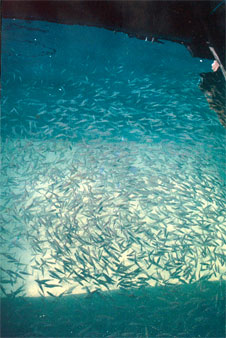 |
As of January 2012, Superior Raceways™ have been successfully used to cultivate yellow perch, bluegills, hybrid sunfish, catfish, trout, koi, walleye, bass, baitfish, and others. Sizes have ranged from very small fingerlings thru adult. It would be fair to say, as in most aquaculture operations, success of a particular species will relate directly to the schooling nature of the fish and the higher stocking densities that a species will tolerate.
Much of the information below regarding catfish is applicable to most species. If you are interested in a particular species, please contact us for additional information.
|
|
U.S. Catfish Farmers
|
Catfish farming in the U.S. represents, by far, the largest segment of U.S. aquaculture (46%) and often leads the way in research and technology. Recent research, much of it coming from Auburn University’s Dept. of Fisheries & Allied Aquacultures, strongly supports the advantages of using “in-pond raceways” over the traditional 6 acre pond culture.
The additional, recent advent of the Superior Floating Raceway™ now offers producers of all species a further breakthrough in efficiency, return on investment (ROI), and environmental stewardship. Researchers are seeking, “…yields of 25,000 to 35,000 pounds of catfish per acre per year, more than three times the state’s (Alabama‘s) average of 8,000 pounds per acre per annum.” (YSI/Auburn report.)
At this time, it appears that raceways of about 10-12 ft. x 70-90 ft. x 4-5 ft. deep may be best.
While some of the highlights of this breakthrough in U.S. aquaculture are listed below, the most exciting fact is that these efficiencies are only possible because the raceways greatly enhance pond water quality. By containing and efficiently removing a huge portion of the fish feces and uneaten feed before it can deteriorate water quality, the raceways allow the pond’s natural flora and fauna to maintain the water quality required for sustained production. This is truly “the greening of American aquaculture”.
Through better control of “bloom and bust” algae growth, super saturation of dissolved oxygen during the day and plummeting levels of dissolved oxygen at night can be mediated, thus reducing the amount of energy necessary for oxygenation. In effect, the system is a “Recirculating Aquaculture System (RAS) Within A Pond”™, or a RASWAP™. Placing the feed and supplemental oxygen, when necessary, where the fish are concentrated only makes sense and significantly reduces feed and energy costs.
One example of many benefits provided by this system is the reduction or elimination of “off flavors”, estimated to cost U.S. catfish farmers “$50 million annually”.
Some Features of System:
- Reduced or eliminated need to regularly drain pond.
- No need to drain pond for Superior Raceway installation.
- Improved energy feed efficiencies.
- Significantly reduced energy consumption.
- Improved water quality.
- The capture and possible “recycling” of 65% of nutrients fed.
- Easy and efficient sorting of fish.
- Accurate and efficient fish observation and health/growth assessment.
- Reduced “off-flavor” issues.
- Effective “off-flavor” purging, if necessary, within raceways.
- Very significantly reduced harvest costs.
- Improved monitoring of water quality.
- Improved feed conversion ratios.
- 100% fish capture from raceways.
- Adaptable to changing water levels, including floods.
- Movable within pond and by truck.
- Easier to maintain than concrete.
- Improved fish health and treatment efficiencies.
- Bird and predator problems reduced or eliminated.
- 15% - 25% the cost of many fixed, concrete raceways.
|
|
Harvesting
|
Harvesting of open pond-raised fish, such as in the catfish industry, can be a frustrating and expensive task for many reasons---especially if the pond isn’t drained. Even if drained, the likelihood of unwanted survivors in the deeper, muddy holes, is often the norm. The result, naturally, is a massive toll on the next planting of fingerlings, as the larger survivors dine at will.
Additionally, the less than perfect sorting practices used with pond-seined fish can result in significant stress on the smaller fish---often associated with delayed disease establishment
As we look at increasing environmental mandates daily, it becomes clear that the less water discharged from fish farms, the safer the farm will be from regulatory sanctions. Thus, minimizing pond draining related to harvesting is probably a good idea for many reasons.
Superior Raceways offer an outstanding opportunity to minimize pond draining (among other problems and expenses) by simply “surfacing” a raceway during harvesting---or for any other reason. Please view the “surfaced” raceway on the lower part of our “Construction Materials” tab. By simply covering the inlet and exit holes with a piece of plastic, and pumping out the water, the raceway will begin to surface---as high as you wish and as fast as you pump.
With a little lifting of the “belly ropes”, starting on one end, you can easily crowd the fish to the deeper end, where they can be further crowded and lift-netted out.
In larger operations, the use if a crane-operated net with a larger semi-circular opening, instead of a fully round hoop, allows the net to conform to the raceway bottom. The net can then be dragged along the smooth bottom, crowding and netting the fish---right up to the raceway end.
The result is a very economical, environmentally Superior harvest by a team of as few as two people. Examination of the labeled diagram under the “Walkway/Dock Options” tab may give you even more ideas.
Naturally, in smaller operations, two people and a very small seine work great.
|
|
|